At a 1979 workers’ compensation seminar for the Michigan Legislature, University of Michigan law professor Marcus Plant closed by noting that “[m]y intent was to sketch in broad strokes the background of our workers’ disability compensation law. It is my firm belief that wise decisions as to where we should go cannot be made unless we know how we got where we are.”
I share Professor Plant’s belief. I feel strongly that wise public policy decisions about where we should go next in the reform process depend substantially on a good understanding of how we got where we are today. Accordingly, I will describe the people, politics, and legislative process that recently resulted in the passage of the Michigan Worker’s Disability Compensation Act.
THE REFORM PROCESS
There are at least three key factors that combined to set the stage for legislative action on this controversial and highly complicated subject: a ten-year development of background information concerning workers’ compensation reform; the 1979 recession which hurt badly the Michigan economy; and finally, a number of the central characters in this legislative process became totally committed to the passage of a bill satisfactory to both Democrats and Republicans. I want to explain the workings of these key factors in order to illuminate the reform process.
- 1. Development of Background Information
Almost ten years of issue development by various individuals and groups with a direct or indirect interest in workers’ compensation reform finally provided legislative and executive decisionmakers with all of the necessary background information to reach an informed consensus.
In March 1974, for example, Governor William G. Milliken created the Workmen’s Compensation Advisory Commission to review the report of a national commission, study the existing state statute, and recommend legislation. The seven-member Commission, chaired by Theodore J. St. Antoine, then Dean of the University of Michigan Law School, consisted of representatives from business, state government, and organized labor. In addition to its other responsibilities, the Commission was charged “to propose and evaluate any and all changes in the workmen’s compensation system which would correct current abuses.”
After several months of meetings, the Commission could not reach agreement on a set of recommendations. The report, however, did serve as a descriptive study of the major problems and alternative solutions.
The eleven major issues addressed in the report concerned: (1) definition of disability, (2) retirees, (3) amount of compensation, (4) medical benefits and rehabilitation, (5) administrative procedures, (6) redemptions, (7) statute of limitations, (8) role of the Bureau, (9) coverage, (10) insurance, and (11) legal services.
For several consecutive years Governor Milliken mentioned the need for reform in his State of the State address. On April 11, 1979, Governor Milliken sent a special message to the Legislature on workers’ compensation. The Governor’s special message called for a bipartisan legislative/executive task force with advisory members from business and labor. The message also outlined a series of goals for reform legislation to address in the problem areas of adjusted compensation rates, benefit coordination, retirees’, death benefits, waiting period, updating old benefits, rehabilitation, statute of limitations, eligibility, administrative budget, and federal standards.
The remarks accompanying this 1979 agenda for workers’ compensation reform concluded with this assessment of past and present efforts:
“In five years of discussion and negotiation, the issues before us have been clearly defined. We have expert advice and a variety of differing opinions. In the end, however, it will not be the technicians and interest groups who decide the fate of workers’ compensation. It will be this Legislature and this Administration, acting in the best interest of all citizens of Michigan who must and will make the hard decisions that result in comprehensive reform.”
In May 1979, the UpJohn Institute published a paper entitled “Workers’ Compensation in Michigan, Problems and Prospects” in which the author considered the problems of litigation, redemptions, promptness of payment, rehabilitation, benefit levels, and propaganda and costs. The writer also summed up the prospects for workers’ compensation reform as follows:
“This spring the battle is being joined once again. The Governor is searching for middle ground and has assigned the Director of the Department of Labor, C. Patrick Babcock, to serve as a negotiator between business and labor interests. All interested parties appear to be cranking up the public relations machines once again. Whether meaningful, comprehensive reform can be achieved remains to be seen. The time for restrained, reasoned public debate is at hand. Let us hope that everyone keeps their heads.”
Unfortunately, by the time the UpJohn paper was published there was not much middle ground left on this subject. Over the years, business, labor, and other interests — such as the insurance industry and plaintiff’s bar — had not engaged in restrained or particularly well-reasoned debate. Literally dozens of conflicting legislative proposals and counterproposals were offered each year. The task force deliberations also became bogged down because the group was much too large, and the setting was far too public to allow for a meaningful exchange of detailed reform proposals.
The Chief Justice of the Michigan Supreme Court probably best expressed the feelings of most elected and appointed public officials and legislative staff members at this point in the reform process when she said to a group in Lansing, “We all know that there is much dissatisfaction in how the system works… The Legislature has been tied in knots for several years over how to change what we have for something better. And if a solution is at hand, word of it has not reached me.”
Thus, the public policy agenda for discussion and resolution of these issues was established and revised over a lengthy period.
2. The 1979 Recession Hits Michigan
Beginning in late 1979, Michigan’s economy had begun to slow. As the nation moved into a recession, the resulting downturn in auto production started to have a severe effect on the general public in terms of high inflation and high employment. State government also began to feel the pinch of rapidly increasing operating costs and social/welfare expenditures and decreasing revenue. By early 1980 Michigan’s economic problems were clearly going from bad to worse, and some individuals and groups not usually concerned about the state’s “business climate” began to express some concern that the legislature should do something about the real or perceived problem of workers’ compensation in an effort to forestall any further plant closings or relocations.
3. A Bipartisan Effort to Pass Legislation
Starting in February 1980 a series of initially unrelated events began that eventually resulted in bringing the right people together at the right time and place to resolve this issue. In response to a December 1979 proposal by Governor Milliken for a scaled-down version of the measure outlined in his April special message, the Senate Majority Floor Leader and Chairman of the Senate Labor Committee offered a counterproposal described as a “business/labor consensus.” In retrospect what was most significant about this proposal was not so much its content — which later proved to be too labor-oriented to provide a broad enough coalition to garner the necessary votes for Senate passage — but that the Governor for the first time became personally drawn into the reform process. The sponsor of the “consensus” proposal, at least temporarily, enjoyed an equal footing with the Governor; and the business-oriented conservative minority Senator who for years had led the fight for workers’ compensation reform was for the first time not directly involved in the reform process.
It is also important to note that for the first time a significant break existed in the business community’s position on this issue. This break occurred when an organization representing low-wage to moderate-wage employers (primarily retail merchants) broke ranks and endorsed the consensus proposal at the expense of high-wage employers (mostly manufacturers).
In March 1980 several other seemingly unrelated events occurred. First, House Bill 5606 was introduced in the House to amend the Michigan Employment Security Act to temporarily increase the number of members of the Board of Review. Second, Senate Bill 1044 was introduced in the Senate to amend the Workers’ Disability Compensation Act, adding the logging industry to the dust and silicosis disease fund (which limited employer liability to $12,500 per claim), in an effort to promote economic development in the Upper Peninsula by reducing the cost of doing business for the logging industry. Finally, steadily increasing long-term unemployment added to the demand for an unemployment benefit increase.
Throughout the spring of 1980, one piece of workers’ compensation legislation after another was fought to a standstill on the floor of the Senate. After several months it looked as though the legislature and administration could not reach agreement on even a scaled-down proposal, and the legislature recessed for the summer. Throughout the summer however, various individuals and groups maneuvered behind the scenes to continue discussion of a balanced, if no longer comprehensive, package of workers’ compensation reform measures.
At this stage in the reform process the number of issues on nearly everyone’s agenda had been scaled down to three basic categories for legislative action: (1) benefit increases, (2) reform measures, and (3) administrative changes.
First, the discussion concerning benefit increases focused mainly on organized labor’s demand for retroactive and prospective cost of living adjustments for disabled workers; a substantial increase in weekly benefits having been tentatively agreed to earlier by most parties.
Second, the agreement about reform measures centered on the retiree issue and benefit coordination. The retiree question was particularly difficult for Democrats and the unions to deal with objectively in public because, although Michigan is one of the few states to routinely pay retirees’ benefits for wage-loss replacement, retirees remain voting members in one of this state’s largest and most politically active unions.
Two main problems concerned “benefit coordination”, a procedure for offsetting workers’ compensation by the amount of other employer financed benefits such as unemployment compensation, short term or supplemental disability insurance, pensions, and onehalf of Social Security.
For one, there was substantial disagreement about the amount to be saved by employers, and secondly, concern existed as to the impact full benefit coordination would have on the availability of legal services if weekly benefits or redemptions were reduced below a level adequate to attract and retain capable attorneys on a contingency fee basis. Other reform measures, such as a reasonable statute of limitations and some limited changes in the standards for heart and mental disability or injuries resulting from social or recreational activities, were comparatively easy to negotiate.
Third, the administrative changes offered by the administration all basically attempted to eliminate or reduce the excessive backlog and delay of claims and appeals. Because these changes tend to benefit employees and employers alike, they were fairly easy issues upon which to reach a consensus.
4. The final movement toward passage of the act
When the legislature returned in the fall of 1980, most individuals and groups with an active interest in workers’ compensation reform had publicly given up any hope of reaching a compromise. Many feared that the November election for the House of Representatives, a lame duck legislature, coupled with an approaching holiday season, would put an end to the reform process for the 1979-1980 legislative session.
Then the unexpected happened. At a public appearance in the Upper Peninsula Governor Milliken indicated tentative support for Senate Bill 1044. He promised to do something about the high cost of workers’ compensation for the logging industry when he returned to the State Capitol. Many observers took these comments to be a change in the Governor’s long-standing opposition to anything less than balanced workers’ compensation reform.
Accordingly, the Senate Labor Committee promptly reported out the bill. About the same time, House Bill 5606 passed the House without amendment and very little debate. Soon it too was reported out of committee, and a very difficult and time consuming floor fight began in the Senate over both bills.
First, Senate Bill 1044 was argued to a standstill by Senators from both parties who were reluctant to act on workers’ compensation legislation without providing disabled workers with increased benefits and other employers with long-sought reform measures.
Then, House Bill 5606 was amended, with bipartisan support, to deal with the voluntary quit issue. By addressing this extremely controversial subject, the informal understanding that had allowed this bill to move through the legislature despite the deadlock on workers’ and unemployment compensation reform was broken. After an unsuccessful attempt to remove the voluntary quit/rework requirement that had been added to the bill for employers, employee interests were successful in adding an extraordinarily large benefit increase to the bill and then forcing quick Senate passage.
Governor Milliken made it apparent through public comments that a smaller unemployment benefit increase was probably overdue, because the Consumer Price Index had increased more than fifty percent since the last benefit increase in June 1975. The Governor also made it clear in private meetings with Republican legislative leaders that he did not want to have to veto the bill. Republicans in the House and Senate argued (at first without much success and later successfully) that the workers’ and unemployment compensation reform should be linked. Publicly, Democrats and organized labor still wanted legislative action on both subjects. In private talks, however, it became increasingly apparent that with a growing number of the rank and file out of work organized labor was more interested in an unemployment benefit increase than workers’ compensation reform.
Shortly after the unemployment compensation bill was sent back to the House for concurrence, the Speaker of the House (Democrat Bobby Crim from Flint) decided to become personally involved in the reform process. The Speaker approached the Senate Majority and Minority Leaders with an offer to hold House Bill 5606 in conference committee until the Governor and legislative leadership could personally negotiate a compromise package on both pieces of legislation and settle this matter.
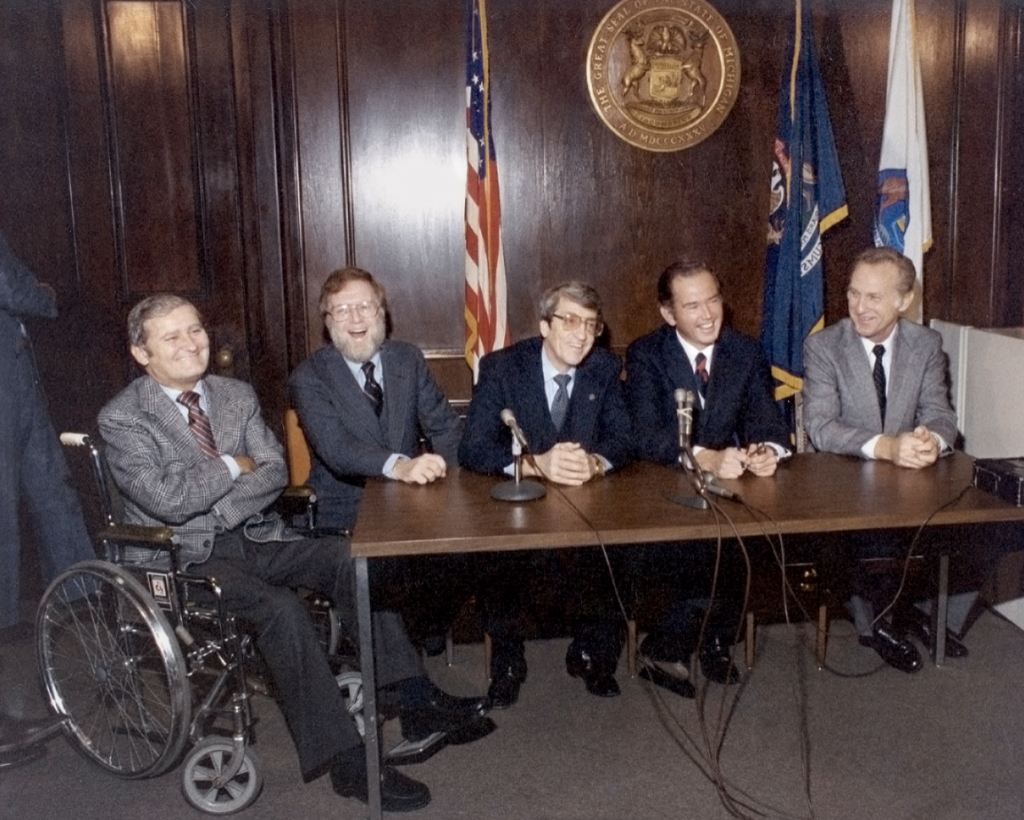
Eventually the Governor and four legislative leaders agreed to send both bills to conference committee and began a series of private negotiations in the Governor’s conference room. Central to this agreement was the understanding that all of the major protagonists who had battled each other over these two subjects for almost ten years would be excluded from these talks and that the negotiations would be kept private.
The negotiations began without the two Senators who had taken extreme positions on each side of the issues, without business and organized labor, and without coverage by the news media. It was also agreed that each principal to the negotiations would only be accompanied by one staff member. This approach successfully avoided most of the procedural difficulties experienced with the task force. Placing both bills in conference also reduced the political pressure interest groups were attempting to apply to the participants because it appeared that both problems had been put on hold at least temporarily.
5. The compromise: The Michigan Workers’ Disability Act
Following several days of “on again, off again” meetings that were often difficult and always time consuming, the Governor and legislative leadership reached an agreement on both bills. Neither side was able to obtain everything it wanted — possibly a good indication of the degree of balance this compromise represents.
In unemployment compensation, weekly benefits were increased to seventy percent of a worker’s after tax earnings, not to exceed fifty-eight percent of the state average weekly wage; the number of weeks a person must work to establish a claim were increased to eighteen the weekly earnings requirement was increased to $67; and a voluntary-quit/rework requirement was established.
These major changes took effect March 1, 1981, and expire in 1983.The sunset provision was a very important aspect of the agreement on this issue because employee interests see the provision in collective bargaining terms as a wage reopener. Others see it as an opportunity to revise or expand on the reform measures now contained in the Act.
In workers’ compensation, weekly benefits were raised to ninety percent of the state average weekly wage, not to exceed eighty percent of after-tax earnings; already disabled workers
will receive an annual supplemental adjustment of their weekly benefit amount of up to five percent, based on the annual change in the state average weekly wage; minimum rates for general disability were eliminated in response to a 1973 Court of Appeals case, Jolliff v. American Advertising, in which the court held that minimum benefit levels must be adjusted annually like maximum benefits, which resulted in many low wage claimants receiving workers’ compensation benefits in excess of their gross wages; a two-year statute of limitations was established. Injuries resulting exclusively from social and recreational activities were excluded from coverage under the Act in response to cases like Nemeth v. Michigan Building Components, in which the Supreme Court upheld a claim for compensation by an employee who was injured after hours making a doll house for his daughter on an employer’s saw.
Eligibility standards for heart and mental disability were strengthened in response to cases such as Zaremba v. Chrysler Corp., and Deziel v. Difeo Laboratories in which the Supreme Court expanded the workrelatedness test to include almost any evidence of relationship to employment.
Finally, a rebuttable presumption that a retiree who is not working and is receiving a pension has not suffered a loss of wages was established to eliminate or reduce the payment of weekly or wage-loss replacement benefits to retirees. Although there are other changes contained in the workers’ compensation legislation, these are the major provisions that were hammered out by the Governor and legislative leadership during their private negotiations.
In addition to benefit increases and reform measures, Senate Bill 1044, now Public Act 357 of 1980, also contained a number of “administrative changes” that will hopefully have a significant impact on the administrative and judicial review process.
For example, the bill authorized the Director of the Bureau of Workers’ Disability Compensation to promulgate rules to provide for the reduction of attorney fees for unwarranted late withdrawal applications for hearing; provided the Workers’ Compensation Appeals Board with discretion in the issuance of full written opinions; authorized the Bureau Director to provide employees and employers with assistance to encourage voluntary resolution of disputes; and eliminated “apportionment” (the provision that permitted the last employer of a claimant to include a prior employer(s) as a codefendant).
The legislative intent of all of these administrative changes was basically the same: to eliminate or substantially reduce the workers’ compensation system’s excessive backlog and delay of claims and appeals.
After reaching final agreement, the Governor and legislative leaders publicly announced the breakthrough. A few days later the Legislature adopted the Conference Reports on House Bill 5606 and Senate Bill 1044 by almost unanimous votes.
Senator VanderLaan’s remarks on the Senate floor before the vote on Senate Bill 1044 typify what the Governor and the other legislative leaders said about the compromise:
“I too, would urge support of this package. It’s a balanced reform for Michigan job providers. … It contains much needed administrative changes. And hopefully, it will reduce the excess backlog, and delayed claims, which hurts disabled workers· and employers alike.
… It’s a massive change. For the employee, it’s long deserved and contains some good benefit increases. For the business community, almost every abuse that they have been claiming for years is addressed in this particular package. … I think it’s a bold step forward.”
6. Future directions
What is the future direction of workers’ compensation reform in Michigan? As mentioned earlier, the Michigan Employment Security Act contains a sunset provision that could place one or both issues back on the legislative calendar in 1983.
Organized labor wants additional benefit increases in both categories, and the business community continues to see the need for additional reform measures. If our economy has improved by 1983, the demand for further unemployment compensation benefit increases is likely to lessen slightly. There will, however, probably still be a strong demand for workers’ compensation benefit increases, particularly in terms of cost-of-living adjustments.
Court interpretation of the reform measures contained in the Act will probably result in the need to revise some of the newly added provisions of the Workers’ Disability Compensation Act. And there were many workers’ compensation reform measures that were not included or only partially included in the recent changes – benefit coordination for example.
In addition to the traditional workers’ compensation reform issues, many individuals and groups are increasingly concerned about workers’ compensation insurance and the self-insurance program permitted under the Act. The legislature and administration are also both committed to continued efforts to streamline the administrative/judicial review process. Towards this end, former Lieutenant Governor and Court of Appeals Judge T. John Lesinski has just completed a study entitled the Workers’ Compensation Adjudication Review Project. Implementation of some or all of the numerous recommendations for procedural and statutory changes will probably occupy a considerable amount of legislative and executive time and effort over the next few years.